Have you ever felt real physical pain or discomfort, even when medical tests showed nothing wrong? You might be dealing with Somatoform disorder!
This is a mental health condition that mimics physical illness, causing very real pain, fatigue, or other symptoms, without a clear medical explanation.
Somatoform disorder refers to a mental health condition in which the sufferer can feel the ultimate pain in their body or body parts. Undemonstrable physical symptoms from emotional distress can be defined as SSD.
It is a basic conversion of stress and anxiety turning into body pain. Major emotional stress can occur due to SSD. Apart from that, reassurances sometimes do not work for the patients. This article is written to highlight the major points of Somatic Symptom Disorders with the help of bullet points.
There are five kinds of Somatoform Disorder:
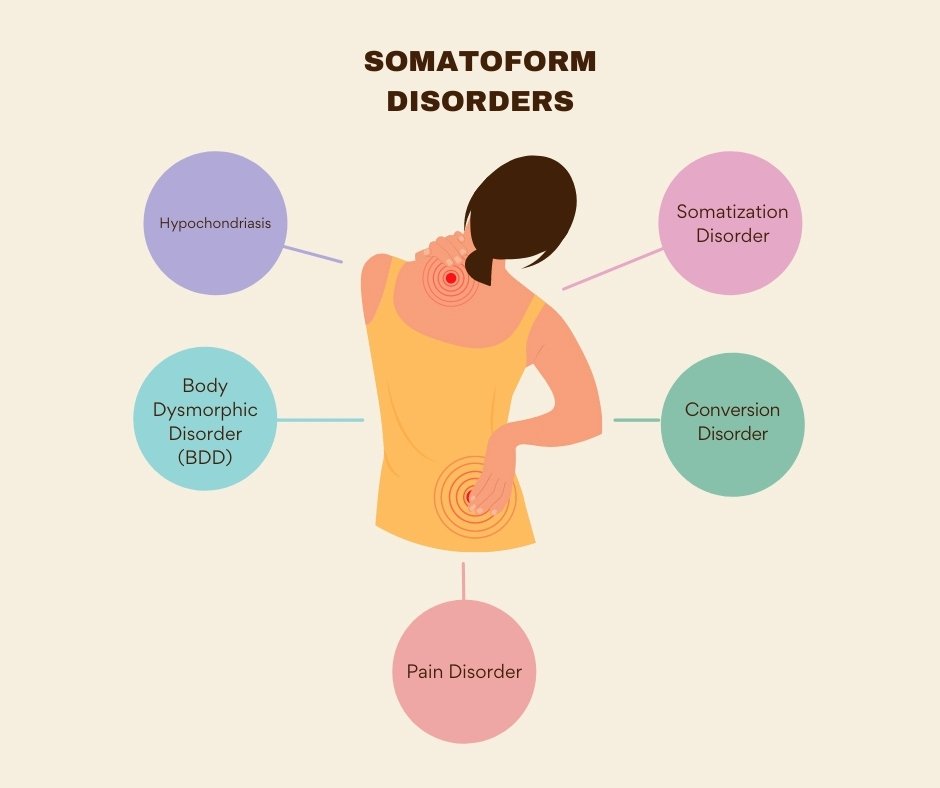
- Somatization disorder – where the pseudoneurological symptoms can cause severe pain and complaints in various body parts.
- Pain disorder – where the constant pain can be caused by anxiety or stress.
- Conversion disorder – where the severe form can damage organs by affecting voluntary motor and sensory functions.
- Body dysmorphic disorder – where a visionary defect in appearance causes distress and interferes with social functioning.
- Hypochondriasis – where the mind fears having an extreme illness, with the assumption of mild bodily symptoms.
Symptoms that are encouraged by the issue:
Somatoform or Somatic Symptom Disorder (SSD) brings the patients into an entirely painful environment in terms of symptoms and indications of the same. Both physical and behavioral traits are observed in this scenario.
The following points are just some specimens of Somatoform’s indicators:
Physical Symptoms –
- Extreme pain in different body parts.
- Fatigue with nausea.
- Headaches.
- Bloating and other gastrointestinal problems.
Behavioral Symptoms:
- Frustration in each segment where the patients belong.
- Unrealistic expectations can affect relationships with severity.
- Patients become anxious regarding their mild symptoms by assuming them to be a critical, fatal condition.
- Fluctuations in the thought process are heavily observed during the experience of SSD.
- Emotional turmoil is one of the major symptoms of Somatoform patients in cases of behavioral indications.
Onset and Causes that are closely associated with the issue:
Approximately 6 out of 100 people suffer from an unknown medical issue that is deeply associated with their psychological factors. Most of the sufferers are women rather than men, according to the 26 studies.
This issue is something that can be demonstrated as a collaboration of social or environmental factors, psychological factors, emotional and behavioral factors, and sometimes biological factors.
- Social or Environmental Factors:
- Family history: A person becomes more vulnerable if she/he notice some serious illness in the family. Assuming the history of illness, they tend to incorporate the same into themselves.
- Socioeconomic status: An Underprivileged background of education or socioeconomic condition is mostly liable for the increase in risk factors.
- Cultural background: Various cultural backgrounds in different ways affect the behavioral sides of a person, which can automatically create more complications within the mind of the patient with somatoform disorder.
- Psychological, emotional, and behavioral factors:
- Trauma and abuse: Neglecting since childhood, a history of sexual abuse can cause a definite form of SSD, no matter what the time being.
- Stress: Maintaining homeostasis is one of the ability of body; however, severe stress can eventually disrupt the ability to maintain the same.
- Personality indicators: Overthinking, and the people who tend to think negatively call the disorder on their own.
- Substance abuse: A History of any substance use is directly connected with any psychological disorder, as it increases the chance of a higher fatal outcome while having the same kind of disorder.
- Biological factors:
- Genetic or hereditary predisposition: Some recent research has suggested a hereditary component to somatic symptom disorders or SSD. Hence, experts consider biological factors as indicators as well.
- Bodily awareness: People who experience somatic symptom disorders tend to be aware of normal bodily sensations easily. Moreover, to them, it can be alarming by assumption.
Read more: Silent Pain You Still Carry: 8 Signs of Childhood Humiliation Trauma
Resolution of the Somatoform Disorder:
- Consultation with experts or a psychiatrist.
- Proper medication with consultation.
- Psychotherapy from a licensed therapist.
- Family inclusion.
- Relationship building with the patient to discard past traumatic experiences.
Read more: 7 Signs You Are Emotionally Exhausted (And What To Do Before You Burn Out)
Issues that enhanced the complication during diagnosis:
- Patients’ and their families’ reluctance to seek professional help from a psychiatrist.
- Fewer medical advisories related to the disorder.
- No identifiable report status, whereas the patient feels various bodily complaints and chronic pain.
- It has been a controversial issue for a long time. Some of the practitioners were not able to consider it as a core part of their study.
Frequently ASKED Questions (FAQs):
What are Somatoform Disorders?
Undemonstrable physical symptoms from emotional distress can be defined as Somatoform or Somatic Symptom Disorders.
What are the causes of Somatoform Disorders?
People may think differently. Somatoform disorders are caused by social, environmental, psychological, emotional, and biological factors that can affect your presence of mind by absorbing body energy.
How many types of Somatoform Disorders exist?
5 types of variants of SSD exist in the world. It consists of Somatization disorder, Pain disorder, Conversion disorder, Body dysmorphic disorder, and Hypochondriasis.